ProspX.ai

DELIVERED WORK AND ORIGINAL RESEARCH

The work we deliver. The thinking behind it.

Two kinds of evidence. Projects we have delivered, and research we funded and ran ourselves.

Delivered work

Projects and engagements we have been responsible for.

Paid search built around the cases a firm wants

A paid search strategy built around the cases the firm wanted, delivering higher-quality leads at a lower cost per click and cost per lead. Approximately 120 inquiries in a typical month, of which the client assessed 50 to 70 as qualified.

Read the case study

From a restricted platform to a website the firm controls

We rebuilt the site off a restricted platform, carrying 78 pages and 218 posts, with URL mapping, redirects, contact routing and tracking. The firm can now develop its own content and coordinate website, search and advertising together.

Read the case study

Connecting advertisers with hotel guests at scale

ProspX.ai works with partners to develop advertising opportunities across a major global hotel group’s guest Wi-Fi experience, connecting inventory with media planning and advertiser demand. For advertisers, an opportunity to reach travellers during their stay.

Read the case study

Holiday email marketing for a major gifting retailer

ProspX.ai created the email templates and helped execute a portion of the retailer’s holiday email program, through one of the company’s most important selling periods.

Read the case study

62 homes bought or sold in 12 months

ProspX.ai’s paid advertising strategy delivered higher-quality leads at a lower cost per click and cost per lead, with SEO and website optimization coordinated alongside it. In one 12-month period, 62 homes were bought or sold through the firm.

Read the case study

Higher-quality leads at a lower cost per click and cost per lead

ProspX.ai’s responsibility: the paid advertising strategy, SEO and a rebuilt website, coordinated as one effort and optimized continually. The company expanded its staffing and opened a second location.

Read the case study

Original research

We fund and design our own studies, and publish them.

Hospitality · fielded October 2024

Invest in the experience your guests value.

The business question
Which guests actually want personalization technology, and which would rather deal with a person?
The most useful insight
The disagreement is about who delivers the service, not the service itself. Give guests a meaningful choice rather than assuming more technology makes a better stay for everyone.
Explore the findings

Automotive · fielded early 2022

Know what stops a buyer before you write the offer.

The business question
What actually holds back an electric vehicle buyer, when the marketing is arguing about the environment?
The most useful insight
The barriers were practical, not ideological: where to charge, what it costs to run, and seeing the car. Buyers closest to a purchase were the least willing to buy online.
Explore the findings

Hiring · fielded July 2021

Understand what motivates candidates to choose a job.

The business question
Employers could not fill roles. What would actually move the people they were trying to hire?
The most useful insight
Job seekers wanted contradictory things, so a benefit that attracted one group put another off. A separate analysis then matched the groups to the media each was more likely to consume.
Explore the findings

Hospitality · fielded November 2020

Why an overall average can hide the decision.

The business question
Which short-term changes would reassure returning guests, at a point when nobody could afford to guess?
The most useful insight
Averaged across everyone, the most divisive measures looked unimportant. Split by group they were among the strongest signals in the study, in opposite directions.
Explore the findings

What makes someone choose one personal injury firm over another?

Our most recent study. We funded research with 100 qualified participants evaluating combinations of 16 messages, then separately reviewed prominent messaging on 48 personal injury landing pages. Messages participants rated highly were not equally represented in the fields we reviewed.

Fee or free-consultation messaging 31 of 48 pages No fee unless we win, free consultation, or both.
Regular case updates0 of 48 pages
An honest assessment of whether a case is worth pursuing0 of 48 pages

The counts cover the headlines, subheadlines, primary calls to action and main section headings we reviewed.

Explore the personal injury practice and methodology

From insight to execution

How a research finding becomes a message a client can actually run.

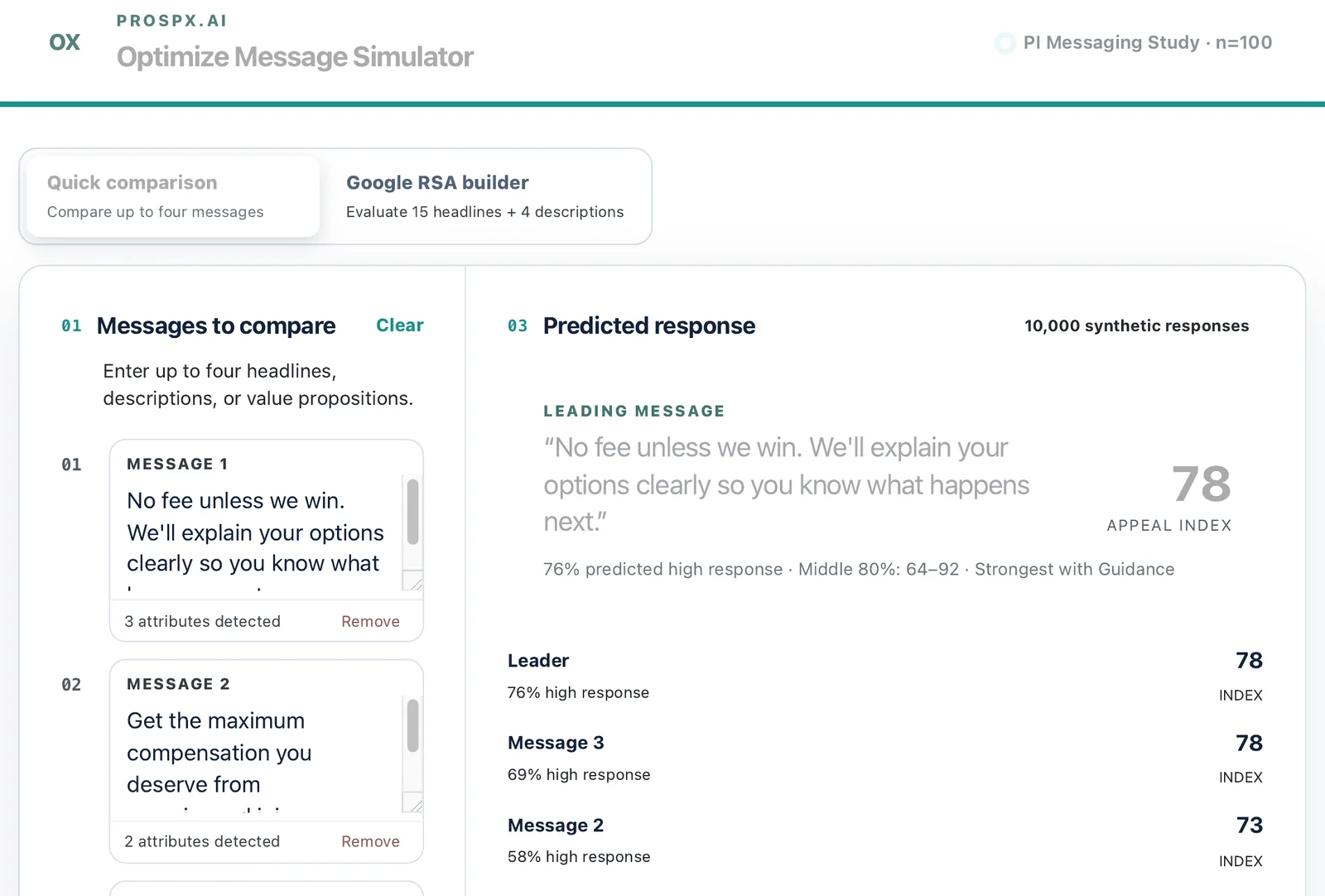
We use Optimize, our research tool, to find out what actually influences an audience’s decision. The simulator is the next step: it applies what the research established to proposed headlines, descriptions and combinations, so we can compare candidates before any budget goes near a live campaign.

Live results, not the model, decide what finally runs. The personal injury model below is our working example.

Screenshot of the ProspX.ai Optimize Message Simulator. The left panel, Messages to compare, holds two personal injury messages entered for comparison. The right panel, Predicted response, names the first as the leading message with an appeal index of 78, and lists the compared messages at index 78, 78 and 73.
Optimize Message Simulator, research-informed messaging comparisons.
How the simulator uses the research

Optimize shows people short combinations of attributes and asks them to rate each one, rather than asking about attributes individually. That is how you learn what someone trades off, not just what they say they like. We use the simulator to compare proposed messaging, then select candidates for live testing in campaigns, websites and landing pages.

Fielding is fast. Our 2020 hospitality study completed fielding in 60 minutes, and the 2024 guest study was fielded and finished in under two hours. Study design, analysis and the work that follows take longer, but the speed of the instrument means research can sit inside a live engagement rather than only ahead of one.

The simulator applies the study’s findings to proposed messaging combinations, including combinations that were not shown together in the original study. Its outputs are model estimates based on participant ratings.

Synthetic responses represent simulated outcomes, not additional people surveyed. Live campaigns establish actual performance.

Have a similar challenge?

Tell us what you’re working toward. We’ll discuss where our experience can help and what a useful next step could look like.